
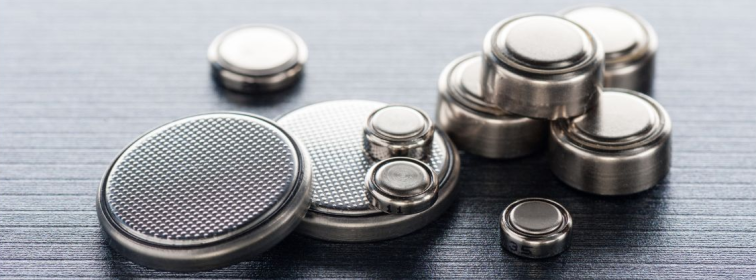
Button batteries – an underestimated hazard in the home for small children

Verschiedene Knopfbatterien
Photo: alexlmx, Canva

Button batteries in daily life – often overlooked


It’s virtually impossible to imagine our everyday lives without button batteries. They are everywhere, including in car keys, remote controls, kitchen scales, cameras, watches, toys and LED tealights. Often, the only time we think about these small coin cells is when a device suddenly stops working: Where is the battery compartment? Which battery does it need – and do we have them at home?
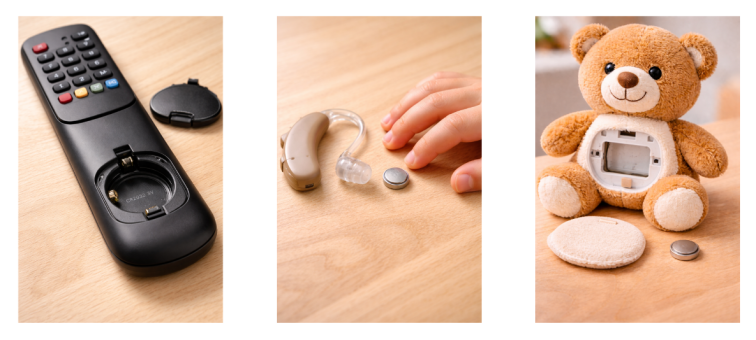

Knopfbatterie sind an vielen Orten zu finden
AI Images: Chat GPT Open AI/Tox Info

But what if the battery compartment is empty and the button battery is nowhere to be found? Didn’t you just see your child playing with the remote control?

You may have been frustrated with tightly screwed battery compartments in children’s toys or the child-safe packaging for button batteries that take a lot of effort to open. It isn’t that the manufacturers want to annoy us. These safety measures are a direct response to a real accident risk – one that is frequently underestimated in the home.

If a child has swallowed a button battery


Kind mit Knopfbatterie in der Hand
AI Image: Chat GPT Open AI/Tox Info

If a button battery has been swallowed, this usually passes in the majority of cases without complications. The battery will be excreted in the stool naturally after 24–96 hours.

The situation becomes problematic if the button battery gets stuck in the oesophagus. If stuck here, contact with the moist mucous membranes can trigger the flow of electricity. This produces a strong alkali at the point of contact, which will burn the surrounding tissue and can cause serious burns, even within a short space of time.

If you quickly identify a battery stuck in this way, it can be removed as an emergency in hospital. Should it be removed promptly, the child can expect a full recovery without lasting consequences.  However, if treatment is delayed this can result in serious injuries to the oesophagus or windpipe, respiratory or swallowing problems and, in some cases, lengthy follow-up treatments. Unfortunately, in rare cases, accidents like this can also be fatal.

Important: 

  1. A button battery lodged in the oesophagus is a life-threatening medical emergency and must be removed urgently in hospital, ideally within 2 hours of swallowing.
  2. If there is any suspicion at all as to whether someone has swallowed a button battery, they must be urgently assessed by a doctor.


Tox Info Suisse recommends

⇒ Prompt and urgent x-ray monitoring to determine the location of the button battery for: 

  • All children ≤ 2 years
  • Button batteries with a diameter ≥ 20 mm
  • All children with symptoms, even if these are very subtle
  • Any difficulty in assessing symptoms in a child

⇒ In any uncertainty do not hesitate to contact Tox Info Suisse. Rapid action is vital.


All button batteries in the nose, ear, vagina, anus or under plaster should always be removed urgently.


Note: Honey or sucralfate

Taking measures such as administering honey or sucralfate to prevent burns after swallowing a button battery are not adequately scientifically proven at present and are not recommended by Tox Info Suisse.

Under no circumstances should the emergency removal of a button battery be delayed as a result of administering honey. Rapid removal using an endoscope in hospital is the most important action to take.

How do you identify if a button battery is lodged in the oesophagus?


Mögliches Symptom: Halsschmerzen.
Photo: satjawat-boontanataweepols-images, Canva

The symptoms may be non-specific and subtle. Some children suddenly refuse to eat or drink, retch, produce more saliva or become unusually agitated. Others complain of pain or a feeling of pressure behind the sternum. In some cases it can cause mild respiratory complaints which resemble cold symptoms.

It is particularly difficult to assess this in infants and young children as they cannot articulate their symptoms. Young children also have a narrower oesophagus, which increases the risk of a battery getting stuck – especially for button batteries with a diameter of 20 mm or more.

Extremely dangerous: Lithium button batteries


Modern devices are getting increasingly smaller and yet use more energy. Since the turn of the millennium, lithium button batteries have therefore been used more and more frequently. A study from the US shows that the number of serious burns has significantly increased. This trend is closely linked to the increased use of lithium button batteries.

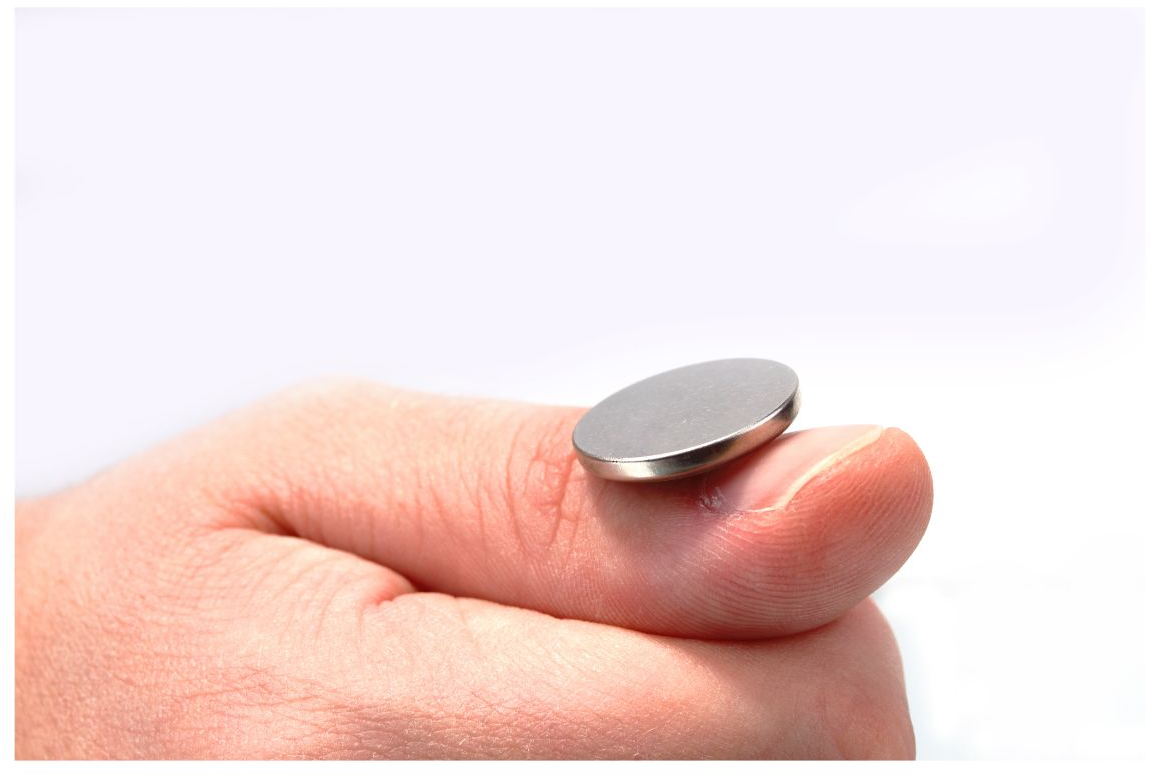
Larger lithium coin cell batteries with diameters of 20 mm or more
such as the widely used CR 2032, CR 2025 and CR 2016 are especially problematic. Their large diameter means they are more likely to get stuck in a young child’s oesophagus and they are now involved in virtually all serious cases.

Knopfbatterie im Vergleich zu einem Daumen
Photo: alexlmx, Canva

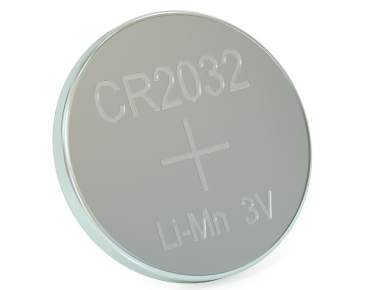
As a guide (lithium button batteries):

Lithium Knopfbatterie mit CR Bezeichnung
Photo: alexlmx, Canva


  • The first two digits of the type designation indicate the diameter in millimetres (e.g. 20 mm for CR 2032)
  • The final two digits specify the height in tenths of millimetres (e.g. 3.2 mm for CR 2032)
  • Lithium button batteries with a diameter of 20 mm or greater represent a particularly high risk for young children

Are dead button batteries harmless?

No. Even button batteries that appear to be dead are dangerous. Their energy is too low to operate a remote control, but the residual current is enough to cause serious injury if it comes into contact with a moist mucous membrane. 


Prevention: How to protect children 


Many serious incidents occur because swallowing a button battery goes unnoticed at first. Studies show that a large number of fatal cases and serious complications occur following ingestion that went unseen. This makes it all the more important to focus on everyday awareness and prevention.


Recommended measures:

  1. Always keep new and used button batteries out of the reach of children.
  2. Check the battery compartments of devices and make these extra secure if necessary (for example by covering with adhesive tape).  
  3. Do not replace batteries in the presence of children (imitation!).
  4. Dispose of dead batteries as quickly as possible in a child-safe location.
  5. Buy button batteries in child-safe packaging where possible.


Addition precautions (not yet conclusively scientifically proven):

  • Mask loose button batteries with clear adhesive tape or packaging tap before disposal – tape horizontally and vertically to overlap and completely cover the battery.
  • This makes it harder to swallow and less appealing to children. It has also been shown in in-vitro studies that taping can significantly reduce the flow of electricity. 

Manufacturer safety measures: Bitters and child-proof packaging

Several manufacturers use safety measures such as child-safe packaging, visual warnings on the battery or bitter coatings such as Bitrex®. Whether these measures actually reduce the number of accidents still remains to be seen.

Further information


April 2026